
(So You Don’t Have to Guess)
The Tax Year 2025, was my second year filing German taxes. This time, I decided to skip the Steuerberater and do it myself. Somewhere between staring at forms in German and cross-checking things with the actual tax law, I learned about how Germany treats Indian rental income. Sharing it here so the next person doesn’t have to start from zero.
Quick disclaimer before we start: this is me sharing what I learnt filing my own return, not professional tax advice. If your situation involves other variables like co-ownership, co-borrowership, or other foreign income like capital gains, it’s worth getting a second opinion from a Steuerberater. This article only covers — rental income from property , jointly filed with spouse.

Do you actually need to declare Indian rental income in Germany?
Yes. It’s one of several foreign income items the Finanzamt wants to know about, even if Germany doesn’t end up taxing it directly.
Wait — so is it taxed, or just declared?
This is the part that confused me the most, so let me lay it out properly.
Under the India-Germany DTAA, Article 6 gives India the right to tax income from immovable property situated there.
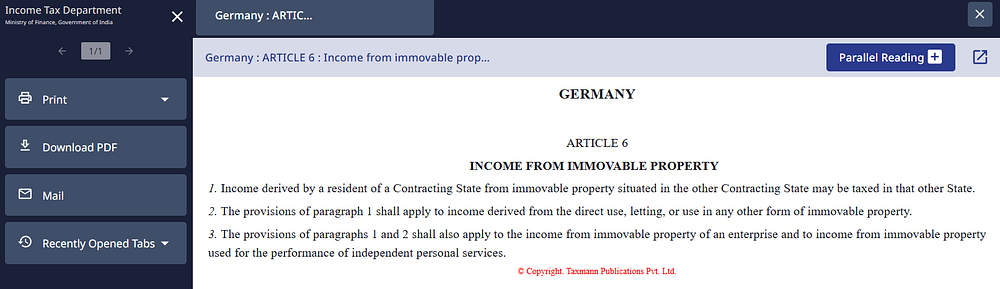
Article 23 (same document) is where it gets interesting for us: it tells Germany to exempt that Indian income from German tax (rather than taxing it and giving you a credit for what you paid in India). So you don’t pay German tax on the rental income itself.
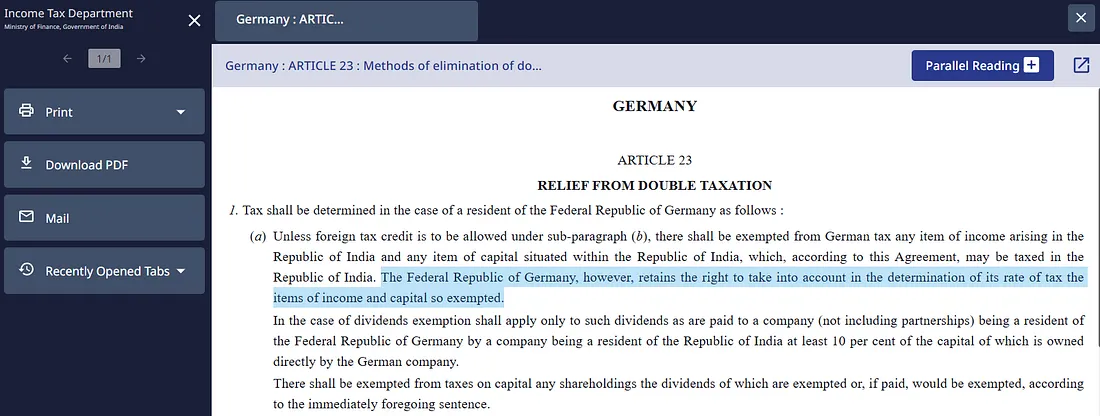
But — and this is the catch — Germany still wants to know about it, because of something called Progressionsvorbehalt (§32b EStG, if you want to look it up).
What is Progressionsvorbehalt?
Germany calculates your tax rate as if this foreign income were part of your total income, even though the income itself stays untaxed. So it can nudge your overall tax rate up, even though you’re not paying German tax on the rent directly.
In simple terms, the rental income is not directly taxed in Germany , but it is added to your total income — which might increase your tax rate.

Tax Changes for 2026 — Refer here. Legal Source: here.
How do you actually compute the number to declare?
Here’s where it gets annoying: you can’t just take the number you used for your Indian tax return. Germany wants it computed as if German tax rules applied.
A few concrete differences I ran into:
- No 30% standard deduction. In India, you get a flat 30% deduction on net rent as a stand-in for maintenance, no receipts needed. Germany doesn’t do this — you can only deduct actual expenses (repairs, maintenance, etc.) that you can back up with invoices.
- Interest deduction is uncapped. India caps the interest you can offset against rental income at ₹2 lakh, with the rest carried forward. Germany lets you deduct the full interest paid for the year — no cap.
- Depreciation exists, and the rate depends on when the building was completed. India has no equivalent concept, but Germany lets you depreciate the building (never the land) under §7 Abs. 4 EStG:
- Completed before 1 January 1925 → 2.5% a year
- Completed between 1 January 1925 and 31 December 2022 → 2% a year
- Completed after 31 December 2022 → 3% a year (this got bumped up by a 2022 law change)
That means, that you need to separate out the value of the building only to compute depreciation. The land on which the building is built is not considered for depreciation. This was a tricky part for me — so I didnt compute the depreciation. There is a guideline on calculating building value — which you can explore.
Converting INR to EUR — don’t just Google the rate
This one has an actual rule behind it (R 34c Abs. 1 of the Einkommensteuer-Richtlinien — a formal administrative guideline, not something with a simple public link, but citable by name if anyone wants to check with a Steuerberater): foreign income should technically be converted using the ECB’s reference rate on the date you received the money, on a monthly basis. As a simplification, the Finanzamt also accepts the monthly conversion rates published by the German Finance Ministry (BMF) — the “Umsatzsteuer-Umrechnungskurse.”
There’s also an annual average rate, which a lot of people use to keep things simple. Worth knowing where it actually comes from: it’s not something the ECB itself publishes as one number — it’s the BMF’s own average of its twelve monthly rates, rounded to the nearest 50 cents. In practice, Finanzamt generally accept it for rental income too, even though the letter that formally introduced it was written with salary income in mind.
Where to find the actual numbers:
- Monthly rates (BMF): [BMF Umsatzsteuer-Umrechnungskurse]
- Historical/daily ECB rates for INR: [ECB euro reference rates — INR]
If your rental income comes out negative, does your German tax rate go down?
No — and this trips people up. If the number is negative, you simply enter it as negative; it does not reduce your total income or your German tax rate. It also doesn’t get added, obviously.
What it does do is carry forward. Under §2a EStG (specifically the provision for third-country rental losses, Abs. 1 S. 1 Nr. 6a), a negative amount can only be offset against positive Indian rental income you earn in future years — it can’t be set off against anything else, and there’s no fixed expiry on how long it can wait. So keep track of it; it’s not lost, just parked.


Quick side note :India lets you carry forward house-property losses too, but it’s a completely separate track. Under Section 71B, an Indian house-property loss carries forward for 8 assessment years, settable only against future house-property income there. And Section 71(3A) caps how much of that loss you can set off against your other Indian income (salary, business, etc.) in the same year at ₹2 lakh — anything above that also carries forward the same way.
The German and Indian carry-forwards don’t talk to each other; they are two independent tracks in two independent tax systems.
Which form do you actually use?
Anlage AUS is the one you want for Indian rental income. This is the form for foreign income that’s either taxable in Germany or affects your tax rate via Progressionsvorbehalt — which is exactly our situation.
Anlage V is for German properties, and generally for properties in the EU/EEA where the exemption method applies the same way. (Small aside if you have property elsewhere in Europe too: the real dividing line is exemption-method vs. credit-method countries, not simply “EU vs. non-EU” — a couple of EU countries work differently under their specific treaties. Doesn’t affect India, but good to know if you’re juggling more than one country.)
What if you only own 50% of the property?
Jointly owned family property is the norm, not the exception. In this case, everything splits by ownership share, on both sides.
On the German side, this is settled by case law on what’s called a Bruchteilsgemeinschaft (fractional co-ownership) — income and deductible expenses (repairs, maintenance, and depreciation) get split according to each owner’s actual percentage. At 50/50, that’s straightforwardly half each. Depreciation specifically follows each owner’s own acquisition cost, which is usually equal at 50/50 unless you paid different amounts or at different times.
On the Indian side, Section 26 of the Income Tax Act says the same thing in its own words: where co-owners have a “definite and ascertainable” share, the property isn’t taxed as one combined unit — income is computed for the whole property, then split by each person’s share, and each co-owner reports their own portion individually.
The one place this can get asymmetric: Interest. German tax law lets you deduct interest based on who’s actually the borrower, not who’s on the title. If the loan is solely in one spouse’s name but ownership is 50/50, that spouse deducts 100% of the interest — the other doesn’t get to claim a share of interest they are not legally liable for. If the loan is joint, it follows the same split as ownership.
If you are using a calculator (including mine) to work this out: check whether it assumes your ownership share and your interest liability are the same percentage. That’s true for most people — usually the same names are on both the title and the loan — but if yours differs, do that piece separately by hand.
If doing this math by hand sounds tedious — it is — I built a calculator on thefinancialhygiene.com that walks through this exact computation: converts your rent, applies the right depreciation rate, nets out interest and expenses, and gives you the number to enter on Anlage AUS. [Link to my tool is here]
If you have filed this yourself and hit something I haven’t covered, drop it in the comments — I will fold it into this piece.
About the Author
I am a software engineer by background, and I have cleared all four exams of the CFP certification program (FPSB India). I write about personal finance and build tools to go with it — the kind that handle the specific details (nuances, edge cases, the fine print) that similar tools skip.
You can find the tools, including one for this article, on the toolkit page: thefinancialhygiene.com/toolkit
If this was useful, a few claps and a share with someone who needs it helps more than you’d think. Follow for more of this kind of deep dive.
Nice Article to understand the nuances about declaring rental income in Germany.