FLEXI CAP = FLEXIBLE CAPITALIZATION
There are many categories of mutual funds and one of them is Flexi Cap fund.
While the name tells the intent, there are more details to it that one should be aware of to understand this fund better.
Before we proceed further, its important to understand what does the suffix ‘cap’ mean?
What is Capitalization?
cap stands for market Capitalization. It refers to the combined value of all the stocks(shares) in the market of a particular company.
For example: If there are 1,00,000 shares of Tata Motors in the market and price for 1 share is 1000 INR, then the market capitalization of Tata Motors will be 100000 * 1000 = 10,00,00,000 INR i.e. 10 Crore INR.
There are around 5000+ publicly listed companies in India. Some have been there since decades and have stable business (like Tata Motors, SBI) while others are growing and expanding at different rates(like Zomato, Ola, Varun Beverages). Their market capitalization also varies.
Market Capitalization is used as one of the measures to classify these companies in different categories as below
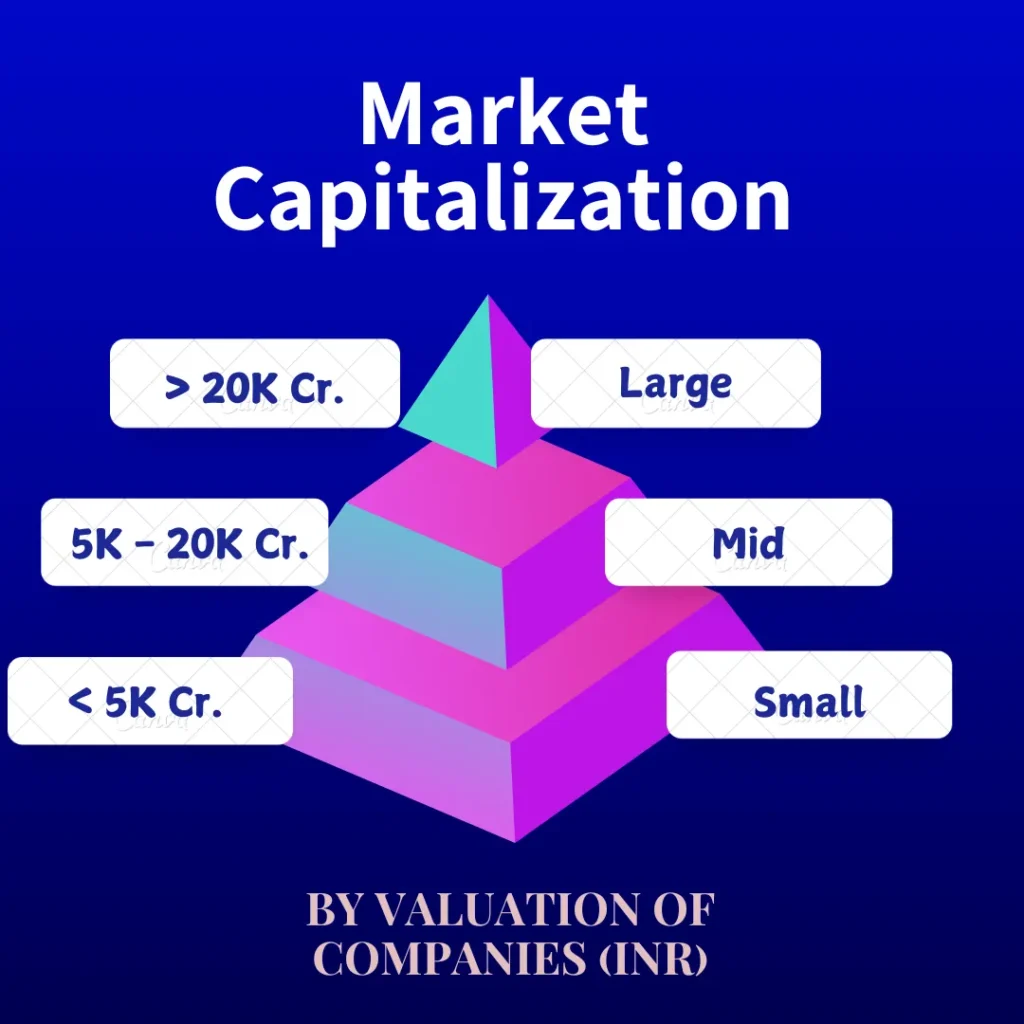
If you see at the image above, the large cap companies form the top of the pyramid and the small cap forms the base, with mid cap in the middle. This represents the number of companies in each of these categories. Out of 5000+ publicly listed companies, only a few make it to large cap and most of the companies are in the small cap.
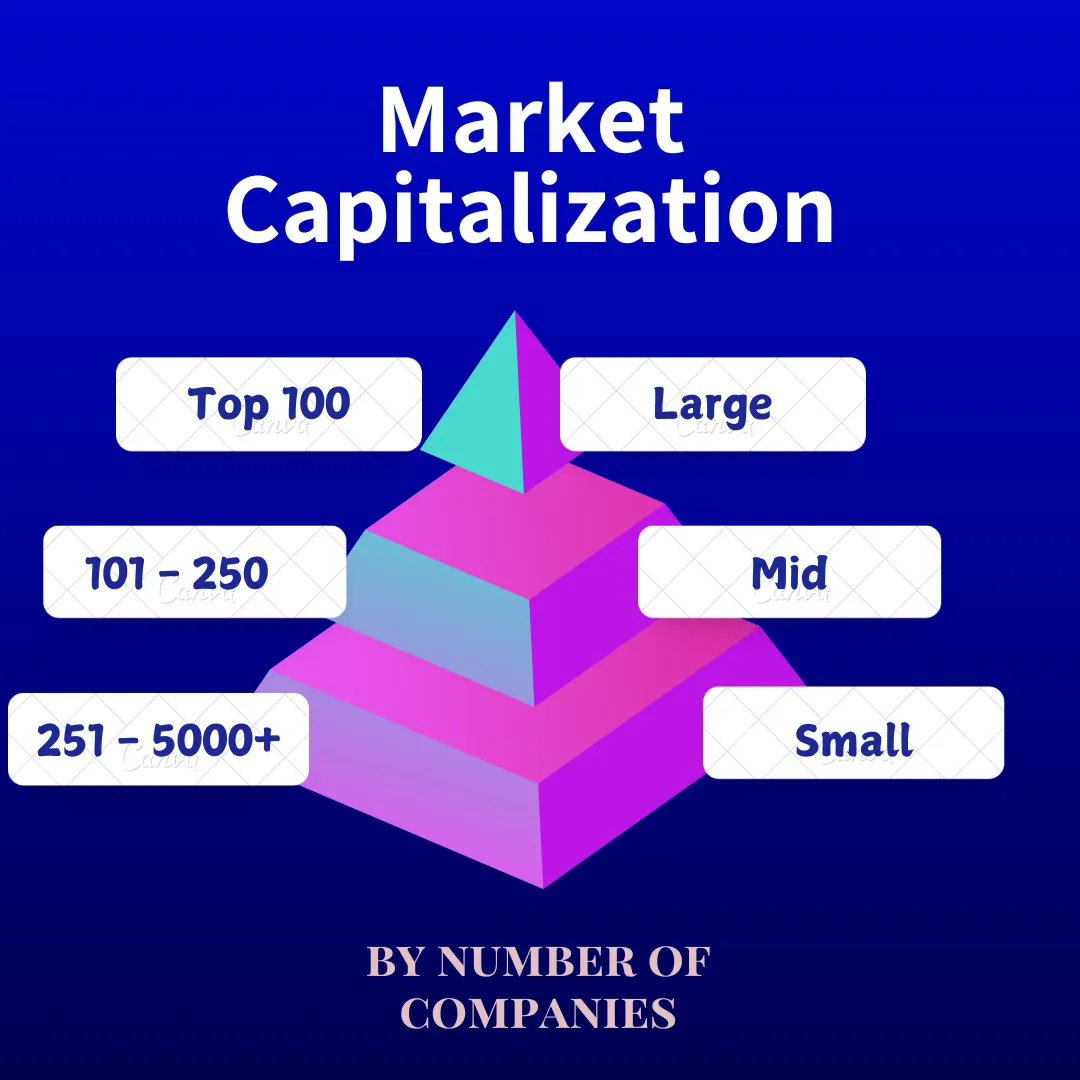
There are various mutual funds available which cater to each of these categories exclusively. i.e. funds which include stocks of only or mostly large cap companies are Large Cap Funds. Similarly we have mid cap and small cap mutual funds.
Which fund to select depends primarily on your risk appetite and goals.
Among each category of these funds, there are several funds by different AMCs. Rolling returns is one of the good parameter to check for the fund performance consistency.
You might say that if we can invest in these funds individually then
Why do we have flexi funds?
Short answer, Not everyone spends time to research, study and track markets and its difficult to predict the market.
Well, this is where the flexibility of flexi cap comes into play.
There could be times where small caps perform really well and then there could be days where they just slump.
Investing in individual funds means in order to maximize returns( i.e. to take advantage of the bullish category), investor should be able to rebalance their portfolios(which means spend time on research, be updated with the market trend and sentiments and be able to decide when to exit a fund).An investor choosing a flexi cap funds in a way offloads the responsibility of rebalancing to the fund manager.
The fund manager is much better equipped with the knowledge and experience in capital markets( it’s his/her day job after all) and can perform the task better than a naive investor(presumably).
Let’s try to understand how does this work?
FLEXI CAP = LARGE + MID + SMALL
Flexi cap funds include a percentage of large, mid and small cap companies. The percentage of each of these can change with time (even become zero) based on the fund manager’s analysis of the market.
- Flexi cap funds have been mandated by the guidelines laid down by SEBI to invest at least 65% of the money it manages in Equity or related instruments.
- Rest 35% can be put elsewhere or into equity itself.
In the 65% equity portion, the fund manager can choose the distribution among large, mid and small cap stocks in any ratio and is NOT bound to invest a minimum amount in each of these.
In general, flexi caps have more of large cap percentage and lower mid and small cap percentage. This provides more stability to the fund as there is more risk associated with small and mid cap funds.
The trade off here is that their returns could be lesser than pure midcap or small cap or multi cap(where there should be minimum 25% each of large, mid and small).
Fund Manager Matters!
It is important to note that in flexi cap funds, the decision to choose the percentage for large, mid and small cap is made by the fund manager and is usually driven by the market conditions, so a good fund manager matters a lot!
The percentage of these categories not only determine the returns but also influences the risk associated with the fund.Lets try to understand this with an example:
As of date January 28th 2025, below are the details of 2 different Flexi cap funds:
and how they performed in the last 1 month (where markets are down by 10%)